If you live in Miami-Dade, Broward, or most of South Florida, your tap water is disinfected with chloramines, not free chlorine. This distinction matters for three reasons: chloramines have different health and household effects than chlorine, standard carbon filters remove them far less efficiently than chlorine, and once a year your utility switches back to free chlorine for roughly two weeks, the "chlorine burn", producing the noticeable taste and odor changes that generate calls to every water treatment company in the region.
What Chloramines Are and Why Utilities Use Them
Chloramines are a combination of chlorine and ammonia, specifically monochloramine (NH₂Cl). They serve the same role as free chlorine (killing bacteria and maintaining residual disinfection in distribution pipes) but with different chemistry.
Advantages utilities cite:
- Lower disinfection byproducts: Free chlorine reacts with organic matter in water to form trihalomethanes (THMs) and haloacetic acids (HAAs), both regulated carcinogens. Chloramines produce significantly lower levels of these specific byproducts.
- Longer-lasting residual: Chloramines persist further into distribution networks, which matters for South Florida's warm climate where bacterial regrowth in pipes is a constant concern.
- More stable at higher pH and with organic loading.
Utilities that use chloramines in South Florida:
- Miami-Dade WASD (year-round)
- Fort Lauderdale (year-round with annual free-chlorine conversion)
- Hollywood, Coral Gables, Bal Harbour, Miami Lakes (WASD-served or similar chloramine programs)
The Annual Chlorine Burn
Miami-Dade WASD has performed an annual free-chlorine conversion, sometimes called the "chlorine burn" or "maintenance free chlorine", for more than 30 years, coordinated with the Florida Department of Health and the Department of Regulatory and Economic Resources (RER). Typical duration is about two weeks.
Recent Miami-Dade dates:
- October 16–29, 2021
- September 9–22, 2022
- September 9–22, 2024
- October 13–26, 2025
Fort Lauderdale (example of a local utility running its own burn):
- March 22 – April 12, 2022
During the burn, the utility switches from chloramines back to free chlorine for a short period. The goal is to kill any residual bacteria or biofilm that may have tolerated the year-round chloramine residual. The biofilm-breaking power of free chlorine is substantially higher than chloramines for this purpose.
What residents notice: More pronounced "pool water" smell and taste. Aquarium keepers must adjust dechlorination routines. Some people with skin sensitivities notice more irritation during the burn period.
What stays the same: The water remains safe to drink throughout the conversion. The burn is a planned annual maintenance event, not a response to a contamination problem.
Why Standard Carbon Filters Fail on Chloramines
This is where most South Florida homeowners get surprised. The refrigerator filter they bought for "chlorine taste and odor removal" works fine for the annual chlorine burn, but performs poorly for the other 50 weeks of the year when the water is chloraminated.
The chemistry: Free chlorine reacts with activated carbon through a rapid surface reaction, water contacts the carbon, chlorine is reduced to chloride, and clean water exits. This happens in fractions of a second, so standard granular activated carbon (GAC) works at normal household flow rates.
Chloramines don't work that way. The chlorine-ammonia bond in monochloramine is far more stable, and breaking it requires a chemical decomposition reaction, not just adsorption. Documented published data:
- Standard GAC: Chloramine breakthrough at approximately 10 minutes of operation, the filter stops effectively removing chloramines after just a few weeks of typical household use.
- Catalytic carbon: Breakthrough at approximately 50 minutes, roughly 5× longer effective life than standard GAC for chloramine specifically.
- Carbon type matters: Wood-based carbons outperform coconut-based carbons for several contaminants including chloramines. Coconut GAC is often marketed as "premium," but for chloramine decomposition the catalytic treatment of the carbon surface matters more than the starting material.
What this means practically: A standard whole-house carbon filter marketed as "chlorine and taste/odor removal", whether it's a $150 big-box unit or a $1,500 branded system, may be removing <30% of the chloramine within 6 months of installation. The homeowner thinks they're filtering chloramines; they're mostly filtering particulates at that point.
What Actually Works
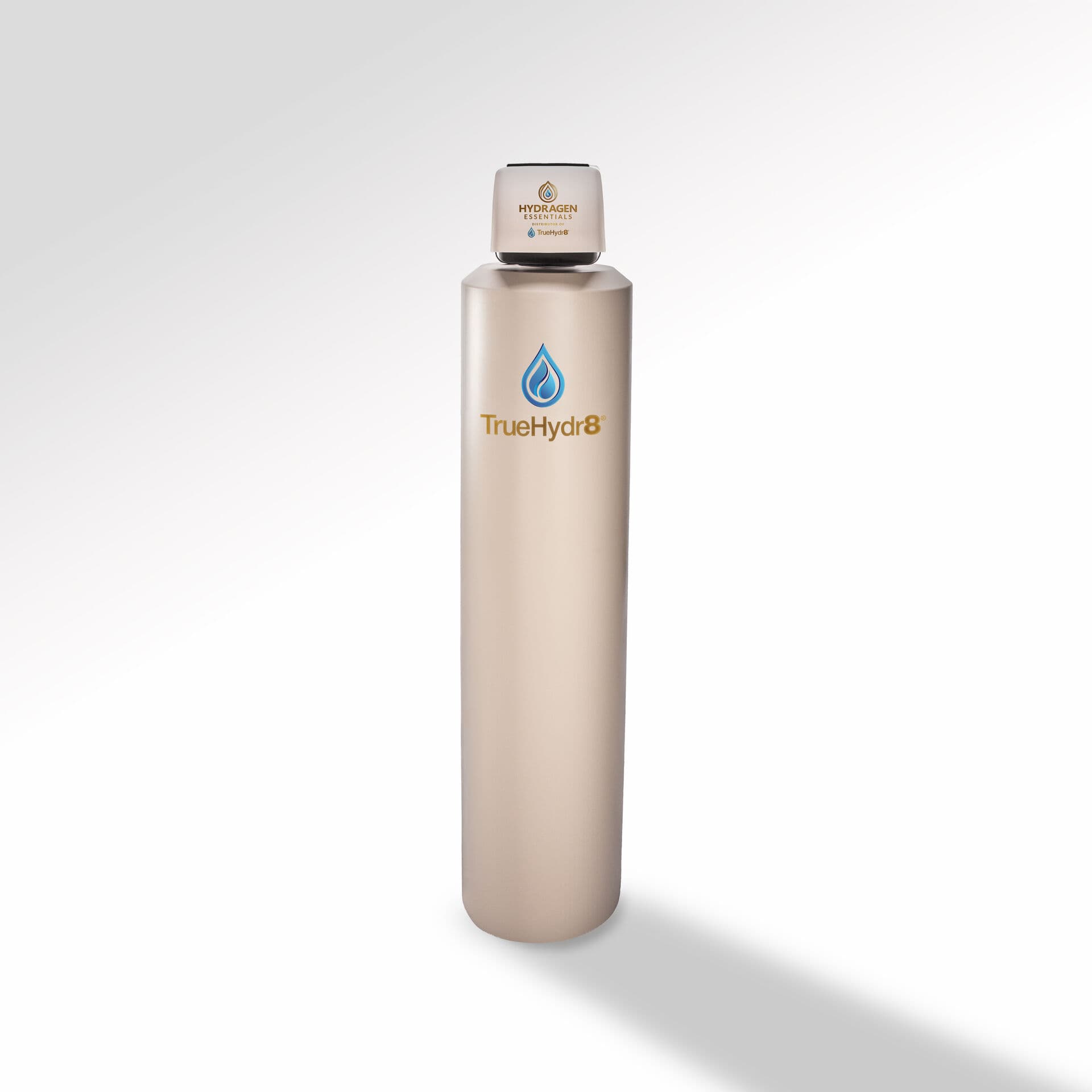
Catalytic carbon media, correctly sized: The media surface is treated to catalyze chloramine decomposition at realistic contact times. NSF/ANSI 42 certified for chloramine reduction specifically (not just "chlorine taste and odor").
Proper contact time: This is about tank size, not just media type. A whole-house unit sized too small for the home's peak flow rate won't provide adequate contact time even with the right media.
Automatic backwash: Extends media life by flushing accumulated sediment and distributing the media evenly.
Under-sink RO for drinking water: RO removes chloramines plus everything else (PFAS, DBPs, residual sodium) as a second barrier.
Aquarium and Pond Owners, Critical
Chloramines are acutely toxic to fish at concentrations present in South Florida tap water. The typical residual of 1–4 mg/L monochloramine is far above aquatic safe ranges:
- Toxic threshold: Chloramine harms fish above ~0.05 ppm.
- Aquatic-safe range: 0.002–0.005 ppm (effectively must be removed).
- Mechanism: Chloramine passes through gills into the bloodstream, binds hemoglobin, and converts it to methemoglobin, which cannot carry oxygen. Fish suffocate even in well-aerated water.
Unlike free chlorine (which off-gasses from standing water within hours), chloramines persist for days in standing water. Letting tap water sit overnight does not dechloraminate it. Dedicated chloramine-neutralizing conditioners (most contain sodium thiosulfate plus an ammonia binder) are required for every water change.
Should You Remove Chloramines from Your Home?
Health perspective: Chloramines at distribution residuals are not acutely toxic to humans. Most healthy adults notice only taste, odor, and occasional skin dryness. However, chloramine vapors can irritate respiratory passages in sensitive individuals, and skin sensitivities (eczema, dryness) improve noticeably in homes with chloramine removal.
Household perspective: Chloramines don't contribute much to appliance scale (that's hardness). They do affect taste and shower experience. A whole-house catalytic carbon system eliminates those effects at every tap.
Aquarium/pet perspective: Required, not optional.
Common Mistakes
- Buying a "chlorine taste and odor" filter and assuming it handles chloramines.
- Replacing catalytic carbon media on a 10-year schedule intended for standard GAC in a softener.
- Skipping NSF/ANSI 42 chloramine certification when specifying a whole-house filter.
Free In-Home Water Testing
HydraGen Essentials tests chloramine residual, hardness, pH, and TDS as part of every free in-home water test, and we design whole-house systems specifically for WASD and chloraminated South Florida utilities. Schedule across Miami-Dade, Broward, and Palm Beach Counties.